Single Seniors: Not Interested in Being Alone

My primary focus on this site is certainly to encourage women to build their own communities as they age; but there is another topic I think is rather important that we consider. What about dating as we age?

photo credit: bravenewtraveler via photopin cc

I’m not talking about living together or getting married, but rather forging loving bonds with other seniors to provide some companionship.

If you’re single but not interested in being alone there are some things to thing about before entering the dating scene.

Singlehood can come upon us in many ways. It may be through divorce or the loss of a beloved husband or partner. Sometimes it can feel like a burden and other times it can feel like a great freedom. This article, from 4Elders.org, provides some great insight to developing relationships as we age and I would love to expand on some of them.

If you’re not interested in being single as you face your later years and move into a new phase of your life, consider these options. In truth, much of this is the same dating advice we should think about throughout our lives but sometimes we need a little reminder.

Click below to read more.

[Read more…]

Settling Conflict in Community Living

photo credit: Aislinn Ritchie via photopin cc

It is important to understand that even with all the benefits of community living, it isn’t always a bed of roses. Conflict between adults happens, even in marriages and between friends. When it comes to living in community it is important to have a peace plan in place to settle conflict respectfully. It can be difficult to separate yourself from the situation because you and your housemates are more than just acquaintances or roommates.  Here are some ideas for dealing with conflict between women living in community.

  • Establish house rules. There are many resources available for designing roommate agreements on line. Use these and talk with your housemates to create a set of rules that will not restrict anyone’s personal freedom but will keep the home safe and orderly. For example, there may be rules about visitors, laundry, cooking, and quiet time. Many of these are common sense but having rules in writing from the beginning is important for dealing with future issues.

Click below to read more.

[Read more…]

Rent or Buy: The Smart Science of Pooling Resources

“Been thinking, if we pooled our financial resources, we could move here, live here year-round.” Hannah held her breath and waited for their reactions.

I’ve been thinking the much the same.” Amelia leaned forward in chair. Aghast, Grace looked at each of her friends in turn. “What is next? I can’t handle any more changes.”

Hannah turned to her. “Let me ask you, Grace, what does Olive Pruitt do for us that we can’t do for ourselves, and for each other? We can even dial 911, imagine that.”

“By pooling our finances, we could live nicely here.”

“Here we could share food, electric, gas repairs, lawn, maintenance, things like that.”

Springing from her chair, Grace flung her arms into the air. “I barely adjust to one thing and you two want to go even farther. There is too much for me. Too many changes!”

“You are tougher, more adaptable than you think,” Hannah retorted. “Things are different now; you won your own life. Time you initiated change.”

“What do you really want, Grace? What is right for you? The three of us sharing a home, helping one another seems very right to me.”

Grace admitted that she subconsciously had been thinking about this idea too.

Amelia hugged Grace, and uncharacteristically Hannah reached out her arms to hug both Amelia and Grace. They no longer felt like three women of a certain age concerned with aching hip, tenuous heart, or a fear of being alone. They were pioneers, driven by hopes and dreams; they were visionaries with sweeping goals.”

Excerpt from “Ladies of Covington Send Their Love” by Joan Medlicott

We all know that sharing a living space can save us money, so why don’t more people do it? American culture often encourages college age students to share housing to pool resources and save money, so it makes sense that the concept can be applied throughout our lives. Boomer women have a chance to blaze a new trail and create communities of women living together. So let’s look at what women can accomplish by pooling their resources.

Click below to read more.

[Read more…]

Tools for Creating Community

As you may know, my mission is to create places for Boomers to grow older in grace and dignity. My big thing is not to wait. If you’re someone who has been talking about these ideas with a friend, don’t wait 10 years. Let’s do it now!


In a radio interview I did earlier this year with Cathy Severson, host of the blog radio show “Retirement Life Matters,” I discuss my six-year circuitous and bumpy path that led to the shared Golden Girls-like home I happily now live in in Asheville, N.C. My goal is to help your path be considerably faster and easier. Here are tools to create community in your life now. Click here for a link to the full 30-minute interview and a downloadable transcript.


How do you get started?
I see three key components for creating community in your life.
Ask yourself:
1. Who are the people you most want to live with?
2. Where is the place you see yourself living?
3. What are key interpersonal tools you’ll need to get along with your housemates?It is critical to begin with a clear vision for yourself of why you want a community component in your housing. Is it economic? For social connections? For health reasons? Or all three combined?

What tools will help you?
I assist groups and individuals to get started by focusing on what I call “My Why?” Ask yourself: Why do I want to do this? When the process gets difficult, you’ll find it helpful to refer back to why you were inspired to create a community in the first place.

I highly recommend the “The Blue Print of We.” You can view this free document produced by The Center for Collaborative Awareness at this link. This is a document we regularly use in our shared house in Asheville both, as a contract with our landlord, and as a working document between housemates. Each of us fills out our own part and then we combine sections for a comprehensive document we’ve all agreed to.

Making decisions is one of the most difficult things to do with a group of people. It’s not about someone winning. It’s about everyone being heard and people feeling included in the decision. We use a form of decision making called “Dynamic Governance.

We also use Non-Violent Communication, a method developed by Marshall Rosenberg. This communication tool enables you to clearly express your feelings and needs and keeps the phrasing to “I” statements, such as, I feel hurt when you ….”. You can access all these documents in the Resources section of my website under “Tools for Getting Along.”

Please contact me if you’re ready to make community happen in your life and create the kind of living arrangement you want for the next phase of your life.

Are You a Good Fit for a Cohousing Community?

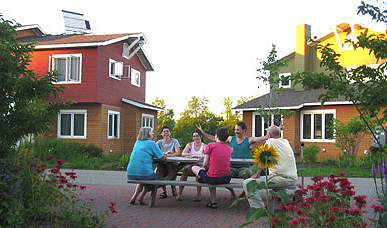
Cohousing neighborhoods are intentionally designed to make connecting with your neighbors easy.

In my last blog, I wrote about five personal traits that, if you have most or all of them, you’re probably a good fit for a Golden Girls-like home. However, living in a house where you share a kitchen, living room and dining space is for some too close for comfort.

If you’re wanting more community in your living arrangement as you look at the years ahead, but need more personal space than living in a shared house, an intentional neighborhood may be the right choice for you.

In this blog, I’ll discuss cohousing neighborhoods. In Cohousing communities residents own their own home and share common spaces and resources. Interestingly, these intentional communities are created by the future resident group who meet each other and work together to decide about the physical design and social agreements of the neighborhood. In many cases, future residents become friends by the time they move-in into the neighborhood.

These collaborative communities are typically between 25 to 35 households, and are home to more than 6,000 people in North America. They are popular because they provide a healthy balance between privacy and community. I know many people who live in cohousing who come from a range of backgrounds, ages and economic situations. They consistently love the lifestyle which they describe as safe, nurturing and FUN.

Spontaneous social gatherings are frequent in cohousing. Kathryn McCamant, one of the co-founders of the Cohousing movement and co-author of the book Cohousing: A Contemporary Approach to Housing Ourselves, says:
“I know I live in a community, because on Friday afternoons, it sometimes takes me 45 minutes, two drinks, and three conversations to get from the street to my front door.’

According to the Cohousing Association of the U.S., cohousing communities have six defining characteristics:
1. Participatory process;
2. Neighborhood design;
3. Common facilities;
4. Resident management;
5. Shared leadership and decision-making;
6. No shared community economy.

This lifestyle has many benefits for Boomers. Residents enjoy an intellectually stimulating and emotionally supportive environment ideal for aging at home in a non-institutional setting. Cohousing residents have privacy when they’re in their private home, and community when they venture outside to the shared common spaces, including common dinners several times a week in the community’s well-used club house or “Common House.”
One of the newer trends in cohousing are elder/senior cohousing neighborhoods designed with Universal Design features to accommodate residents to age comfortably in their homes.

Please contact me if you want to know more about this multi-generational or senior cohousing trend or cohousing in general. In my next blog, I’ll share the characteristics that are most important for living in these socially and environmentally sustainable neighborhoods.

How to share our lives

“Let’s Get Physical”   (Remember the song?)

When we think of community and living IN community one of the first questions asked is? What will it look like?

Through my many years of looking for “my community” I researched, visited sites all over the country, hours on the web, books, seminars,  probing, questioning and soul searching.  Then there were some pretty stupid and costly “lessons” too. You might have to hear about those in person.  I wish I had this book with all it’s wise checklists to guide me along the way back then.

Here is another part of the a checklist from The Sharing Solution by Janelle Orsi and Emily Doskow.  You can get it for free at http://www.nolo.com/legal-encyclopedia/free-books/sharing-book.html.  Check out other resources like this one at  https://www.womenlivingincommunity.com/resources/books/.

A morsel for you from their wonderful book: [Read more…]

How to share?

This week a celebrity came to Asheville, NC, my home town.  She’s a lawyer and she wrote a book that everyone should own.  The Sharing Solution: How to Save Money, Simplicify Your Life & Build Community. The title says is all. Who wouldn’t want to own this book?
We all could share better. We were supposed to learn it long ago as children.  I guess we forgot. I sure did.  Now I am learning. [Read more…]

6 Tips for Finding Others to Share Housing

A large number of you wanted to know how to find others who might be interested in a shared housing experience. I thought I would give you a few pointers about that from my experiences.  The journey starts with you:

TIP #1:   Start by answering a few important questions.  

Why does this resonate with you?
What appeals to you? Look inside you.
The big question is. Why do I want to live in a shared house?
Then start moving outside of yourself to see who else might be in your tribe or your social web who is interested too. [Read more…]
Women For Living in Community