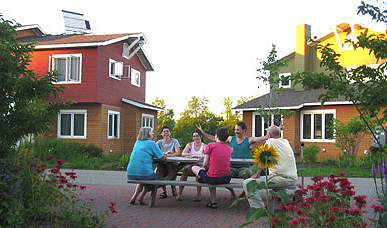
Beyond Age: Multigenerational Living

My primary focus has always been on women developing community to support each other as we age. Much of this comes from my own perspective as a baby boomer living in shared housing with other women near my own age range.

It seems that multi-generational living is currently on the rise. Many factors are contributing to this trend. Adult children are moving back in with their parents in record numbers. Economic realities make shared living situations more affordable for all family members. A generation of aging boomers who saw their parents hidden away in nursing homes is looking for alternatives.

Can families, whether chosen or by blood, foster community that disregards age and creates a situation for graceful aging?

In August of 2012, the AARP blog shared a two part post about the rise of multi-generational living. They shared some important tips on multi-generational families that I think are crucial to consider before establishing a household.

Click below to read more.

[Read more…]

“Who Will Take Care of You?” Learning to Rely on Each Other

Women For Living in Community is about being self-sufficient and self-reliant as we age but the key word there is “Community.” I believe women can be stronger together and we can help each other in ways we may not expect.

In 2012, 37 million American women between the ages of 30 and 84 are childfree by choice or by chance. For generations in cultures around the world it was expected that children would take care of their aging parents. The reality in our country is that many seniors are hidden away in nursing homes and assisted living facilities, even those with children.

There are alternatives.

When we ask the question “Who will take care of you?” what answer are we looking for? Is it possible that we are asking the wrong question altogether?

Click below to read more about community living as we age.

[Read more…]

Are You a Good Fit for a Cohousing Community?

Cohousing neighborhoods are intentionally designed to make connecting with your neighbors easy.

In my last blog, I wrote about five personal traits that, if you have most or all of them, you’re probably a good fit for a Golden Girls-like home. However, living in a house where you share a kitchen, living room and dining space is for some too close for comfort.

If you’re wanting more community in your living arrangement as you look at the years ahead, but need more personal space than living in a shared house, an intentional neighborhood may be the right choice for you.

In this blog, I’ll discuss cohousing neighborhoods. In Cohousing communities residents own their own home and share common spaces and resources. Interestingly, these intentional communities are created by the future resident group who meet each other and work together to decide about the physical design and social agreements of the neighborhood. In many cases, future residents become friends by the time they move-in into the neighborhood.

These collaborative communities are typically between 25 to 35 households, and are home to more than 6,000 people in North America. They are popular because they provide a healthy balance between privacy and community. I know many people who live in cohousing who come from a range of backgrounds, ages and economic situations. They consistently love the lifestyle which they describe as safe, nurturing and FUN.

Spontaneous social gatherings are frequent in cohousing. Kathryn McCamant, one of the co-founders of the Cohousing movement and co-author of the book Cohousing: A Contemporary Approach to Housing Ourselves, says:
“I know I live in a community, because on Friday afternoons, it sometimes takes me 45 minutes, two drinks, and three conversations to get from the street to my front door.’

According to the Cohousing Association of the U.S., cohousing communities have six defining characteristics:
1. Participatory process;
2. Neighborhood design;
3. Common facilities;
4. Resident management;
5. Shared leadership and decision-making;
6. No shared community economy.

This lifestyle has many benefits for Boomers. Residents enjoy an intellectually stimulating and emotionally supportive environment ideal for aging at home in a non-institutional setting. Cohousing residents have privacy when they’re in their private home, and community when they venture outside to the shared common spaces, including common dinners several times a week in the community’s well-used club house or “Common House.”
One of the newer trends in cohousing are elder/senior cohousing neighborhoods designed with Universal Design features to accommodate residents to age comfortably in their homes.

Please contact me if you want to know more about this multi-generational or senior cohousing trend or cohousing in general. In my next blog, I’ll share the characteristics that are most important for living in these socially and environmentally sustainable neighborhoods.

Community . . . what does it mean to you?

COMMUNITY

Such good is gleaned by like minds and interests coming together.
We are at our best when we serve a common cause.
We are inspired and moved by individuals whose interests are similar to ours.
A group manifests a group mind.
Just as “many hands make light work”, many minds make for a more creative vision
Now that we are elders, we relish community more than at any other time of life.
Whatever your interests, services, or spiritual needs, stay connected.
Gather together.

~  From a deck of fabulous and inspirational cards called Crone cards.    

My favorite crone . . . Betty White.